Ransomware: the attack that can sink your SME
Ransomware hits small and medium-sized businesses hardest. How it gets in, what it really costs and what to do before and after an attack.
- Andre Nabais
- 9 min read
- Updated 13 November 2026
In this article
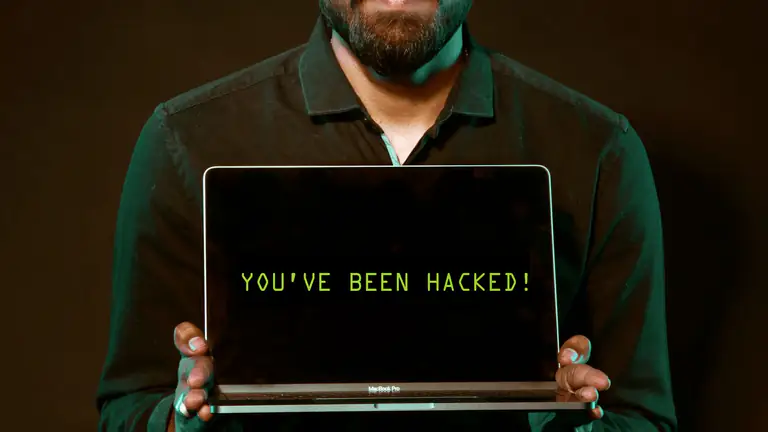
Picture this: you arrive at the office on a Monday morning, switch on your computer and, instead of the usual desktop, a message appears. Every file has been encrypted: the invoices, the contracts, the customer database, the projects your team has been working on for months. On the screen: a ransom demand to restore your access, and a deadline.
This is ransomware. And contrary to what many people think, it does not only happen to the big companies that make the news. It happens above all to businesses of 10, 20 or 50 people, precisely the ones that assume nobody would bother with them.
What ransomware is, in a nutshell
Ransomware is malicious software with a simple aim: to make your data inaccessible and charge you a ransom to release it.
The program gets into the network, spreads as far as it can and encrypts the files, so that they only open with a key the attackers keep. Then comes the payment demand, usually in cryptocurrency, in exchange for a promise to restore access.
And that is all it is: a promise. The No More Ransom project, set up by Europol and the Dutch police together with security companies, is plain about it: paying does not guarantee you will get the key, and it tells the criminals that the attack works.
There is a further twist. Many attacks first copy the data out of the company and only then encrypt it. So even if you restore everything from a backup, you are still threatened with the publication or sale of your customers' data. This is known as double extortion.
Why SMEs are the favourite target
There is a belief that criminals only go after the big fish. The figures say otherwise. In Verizon's 2025 Data Breach Investigations Report, ransomware was involved in almost nine in ten breaches at small and medium-sized businesses; at large organisations, the figure was around four in ten.
The reason is simple. A large company has a security team, detection systems and response plans. An SME often has one server, a few computers, an IT technician who comes in when something breaks, and a sincere conviction that "this won't happen to us". For an attacker, that is the ideal target: little defence, and data valuable enough for the company to want to pay.
What is more, most attacks do not start with someone choosing a victim. Automated tools scan the internet non-stop for out-of-date systems, open remote access and stolen passwords. When they find an open door, they walk in, whether it belongs to a multinational or to a metalwork shop with eight staff.
Being small is no protection
The attacker did not pick your company: they found an open door. And an open door at a small business is just as useful to them as one at a large corporation.
How it gets in, in practice
Real attacks are far less dramatic than the ones in films. In Sophos's The State of Ransomware 2026, a survey of more than 2,000 IT and cybersecurity leaders in 17 countries whose organisations had been hit by ransomware in the previous year, one attack in two began with a malicious or phishing email. Stolen credentials and unpatched vulnerabilities came next.
Phishing emails. A message that seems to come from a supplier, a bank or a colleague, with an attachment or a link. Someone clicks, and the attack begins. You do not have to be careless: these emails have the right logos, flawless language and an urgency designed to make you act before you think.
Stolen or reused passwords. The same password for the company email and for an online shop that was hacked two years ago. Once those credentials are on sale, attackers try them everywhere.
Out-of-date software. Every program, from the operating system to the firewall, has flaws that are discovered and patched over time. If the updates are not installed, known and documented flaws remain open, and attackers know how to use them. In Verizon's 2026 report, exploiting vulnerabilities overtook stolen credentials as the most common way into a data breach.
Exposed remote access. With remote working, it has become common to leave remote access to servers open to the internet. The US Cybersecurity and Infrastructure Security Agency (CISA) explicitly advises against it: poorly protected, it is an open invitation.
None of this calls for sophisticated technology. All it takes is something left undone, which is exactly why prevention is largely in your hands.
The cost goes far beyond the ransom
Talk about ransomware tends to fixate on the ransom. Yet that is often the smallest of the problems.
The shutdown. While the systems are down, the company cannot invoice, produce, deliver or serve customers. Think about what a lost day is worth to your business, then count the days or weeks a recovery can take.
Lost data. Even when you recover, you rarely recover everything. Work has to be redone and records disappear. Without reliable backups, years of history can be lost in one go.
Trust. If customer data was exposed, you have to tell them. Some customers do not come back, and some partners start to have doubts.
Recovery itself. Specialist technicians, forensic experts, lawyers, mandatory notifications. It has its own price, whether or not the ransom is paid.
When an SME closes after an attack, it is rarely the ransom that brings it down. It is the shutdown that follows.
Prevention: the unglamorous work that saves the business
The good news is that these attacks mostly exploit basic gaps, and basic measures, done well, cut the risk considerably. You do not need a bank's budget. You need to do the essentials, consistently. A fuller list is in our article on the safety net every SME needs; against ransomware, these are the ones that matter most.
Backups out of the attack's reach. This is the most important measure. With a recent, intact copy, ransomware loses most of its power: you restore and move on. CISA recommends encrypted backups, kept offline and tested regularly, because many attacks seek out and delete every backup they can reach. The best-known rule of thumb is 3-2-1: three copies, on two different types of media, one of them off site and disconnected from the network. And a backup that has never been restored is a hope, not a backup.
Two-step verification. On email, remote access and business systems. Even if someone learns the password, they still need the second step. Where possible, choose security keys or authenticator apps, which resist phishing better than codes sent by text message.
Up-to-date systems. Operating systems, software, firewalls and network equipment, with automatic updates wherever possible.
Access only where it is needed. Each person gets access only to what their job requires. If an account is compromised, the damage stays with that account instead of reaching the whole company.
An alert team. People are not the weak link when they know what to look for: being wary of unexpected emails, checking before clicking, never reusing passwords.
If you only do one thing this week
Check that you have recent backups stored off the network, and restore one to be sure it works. A backup that works turns a disaster into a setback.
What if it has already happened?
However well prepared you are, it pays to know how to react, and to keep a cool head.
Do not pay in the heat of the moment. Paying funds crime, does not guarantee recovery and marks the company as one that pays. More and more victims refuse: in Verizon's 2026 report, almost seven in ten ransomware victims did not pay the ransom.
Isolate the affected machines. Disconnect them from the network, wired and wireless, to stop the spread. Isolating is not the same as wiping or reformatting in a hurry.
Preserve the evidence. The traces of the attack show how they got in, what they took and how to stop it happening again. They may also be needed for legal purposes.
Call in professionals. Incident response specialists contain the attack, assess the damage and recover safely. Trying to fix it alone usually makes things worse.
Report it. In Portugal, CERT.PT, part of the National Cybersecurity Centre (CNCS), is the point of contact for incidents. If personal data is involved, the GDPR requires notifying the data protection authority (in Portugal, the CNPD) within 72 hours, unless the breach is unlikely to put people at risk. And if the company falls under NIS2, a significant incident requires an early warning to the CNCS within 24 hours. Both deadlines apply across the EU; outside Portugal, the report goes to your own country's authorities.
Part of something bigger
Ransomware is the most visible face of a reality many companies have yet to take on board: IT security is no longer optional.
The law is pushing the same way. Decree-Law No. 125/2025, which transposed the NIS2 Directive in Portugal and has been in force since 3 April 2026, requires many companies to have security policies, backups, incident management and training. These are almost exactly the measures that protect against ransomware. To find out whether your company is covered, read our guide to NIS2.
The difference between the companies that survive an attack and those that close is rarely luck. It is preparation. And most of that preparation is within reach of any SME: tested backups, two-step verification, up-to-date systems, well-managed access and an alert team. It is not rocket science. It is discipline, and it costs far less than recovering from an attack.
We are a Porto software company with a senior-led international team, and we work with partners who specialise in security and compliance. If you do not know where to start, or would rather be sure everything is properly set up, we begin with an assessment.
Could your company recover from an attack tomorrow?
Request a free security assessment. We tell you what is exposed to ransomware and where to start, with no jargon and no obligation.
Sources
- Verizon, 2025 Data Breach Investigations Report: Small- and Medium-Sized Business Snapshot (external site), 2025.
- Verizon, 2026 Data Breach Investigations Report (external site), 2026.
- Help Net Security, Lessons for organizations from the Verizon 2026 Data Breach Investigations Report (external site), 25/05/2026.
- Sophos, The State of Ransomware 2026 (external site), 2026.
- CISA, #StopRansomware Guide (external site), 2023.
- No More Ransom (Europol), home page and advice for victims (external site).
- General Data Protection Regulation, Article 33 (external site), EUR-Lex.